
Rain Accidents: Do car accidents increase on rainy days?
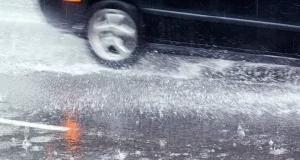
Yes, they do, and significantly so. Rainy days greatly increase the likelihood of a traffic accident. That’s why it’s important to pay special attention when driving in unstable weather conditions. Driving carefully is always essential, but when it rains, even more caution is required to avoid rain-related accidents.
Even pedestrians need to stay alert when crossing a street, avenue, or road. The dynamics of traffic change with rain, snow, ice, and strong winds. Vehicles’ operational capabilities decrease. Street crossings and highways become notably riskier, as do poorly maintained roads.
About 75% of weather-related car accidents happen on wet pavement, and 47% occur while it’s raining. Every year in the United States, over half a million people are injured in accidents on wet pavement, according to the Department of Transportation (DOT). Given these rain-related accident statistics, it’s crucial to understand how we can protect ourselves on the road and what measures to take to reduce these risks.
Below, we share more information about rain-related accidents, safety tips, and what to do in case of an incident in these conditions.
How does rain affect driving?
Driving under normal conditions requires knowledge, attention, responsibility, good reflexes, and clear vision. When the weather is rainy or unstable, all these factors become even more important. Water, snow, ice, and strong winds can be fatal while driving.
When roads are wet, flooded, or covered with snow or ice, tires lose grip. This happens to cars, trucks, and motorcycles. The grooves in tires fill with water, increasing the chance of skidding.
Sometimes, a road that wouldn’t be a problem in good weather becomes very dangerous when it rains. For example, avoiding a pothole may be simple on a sunny day but very risky on a rainy day.
Traction and the ability to maneuver are seriously affected on wet surfaces. Vehicles’ ability to function efficiently decreases.
The main dangers of rain while driving include:
- Low visibility from all angles and mirrors
- Reduced vehicle operating efficiency
- Lack of grip and traction, making it harder to maneuver
- Difficulty braking, which requires double the stopping distance
- Poorly maintained roads
Should you reduce your speed when roads are flooded by rain?
Yes. It’s crucial to reduce speed when driving in adverse weather conditions, such as during heavy rain or strong winds. The ability to brake is significantly reduced when the road is wet. The ability to take a curve properly is also diminished. When the pavement is wet, touching the brake while in a curve can be very dangerous.
Adding to this is reduced visibility. Not just from the rain itself, but also from what is known as “precipitation fog.” The ability to see clearly diminishes both in general vision and in mirrors, which already tend to have blind spots.
Braking during rainy days is especially delicate. The distances at which you need to start braking change significantly. It’s estimated that on wet ground, you need double the braking distance. Operating the vehicle, in general, requires much more skill from the driver. Knowing how to brake in the rain is very important.
Lack of awareness, responsibility, and/or driving skill can easily lead to accidents when the weather is unfavorable. The first risk is undoubtedly your own health and that of those around you.
A second danger of not taking necessary precautions is that in the event of an accident, the court may rule that the victim is partially at fault, which could directly affect their chances of receiving compensation in a case or settlement.
What precautions can be taken when driving in rain and snow?
It’s essential to keep tires in good condition. Worn tires can be dangerous, especially on a rainy day. Replacing old tires is a smart way to protect yourself and your family. Additionally, strong winds can increase the risk of accidents, so it’s important to be prepared for these conditions as well.
A car or motorcycle battery can fail in cold weather, so it’s wise to pay attention to its condition. Keeping the windshield wipers up to date is also important, as is ensuring all lights are functioning. General vehicle check-ups are always a good idea, rain or shine.
Is it possible to receive compensation if I’m partially responsible for the accident?
In the United States, each state has its own laws. The degree of responsibility or negligence in a traffic accident could affect your compensation in different ways depending on where you live. There are three types of fault:
- Pure Comparative Fault (or Comparative Negligence)
According to this law, the injured victim has the right to sue and can recover financial compensation for the damages, even if the plaintiff is partially responsible for the accident and injuries. In fact, if you were 99% at fault for the accident, you could still sue. However, your compensation would be reduced according to the percentage of fault. For example, if you are found to be 70% at fault and the damages amount to $100,000, you would be entitled to 30% of the total: $30,000. - Modified Comparative Fault
Modified comparative fault works similarly to pure comparative fault, with one key difference: you can be partially at fault, but only up to 50%. If it’s determined that you were more responsible than the defendants for the accident and injuries, there will be no compensation. Some states apply a 51% rule, meaning the plaintiff can be partially responsible up to 50% (or 51% in some cases), but if it’s determined that the fault exceeds that percentage, they cannot recover compensation. This varies by jurisdiction. - Strict Contributory Fault
Strict contributory fault applies in a few states: Alabama, D.C., Maryland, North Carolina, and Virginia. In this type of negligence, if the injured plaintiff is partially at fault (even just 1%), they will not be entitled to any compensation. This can be difficult for the victim to accept, but in certain cases, a lawyer could find a way to argue against this restriction.
Who can be sued after a rain-related accident, strong winds, and other adverse weather conditions?
As an injured passenger in a rain-related car accident with strong winds, you may be entitled to file a claim against:
- The driver of the vehicle you were in.
- The driver of your own vehicle.
- Drivers of other cars.
- Ground transportation companies.
- Car rental and ridesharing companies.
- Vehicle or part manufacturers.
- Government authorities responsible for road maintenance.
What kind of compensation am I entitled to?
The victim of an accident may be entitled to compensation for the physical, economic, and/or psychological damages caused by the incident. The affected party could receive compensation for lost work hours, property damage, and/or medical expenses caused by the accident. The amount will depend on each case, but here’s an illustrative example:
A 35-year-old worker, earning approximately $40,000 annually, suffers a car accident on a rainy day that results in multiple leg fractures, requiring surgery and physical rehabilitation.
The inability to work for six months leads to a significant loss of income. The surgery costs about $25,000, and rehabilitation costs around $1,500 monthly for six months, totaling $9,000.
Thus, the compensation should include the total medical costs of $34,000, between surgery and rehabilitation. Adding in the lost income for six months, around $20,000, the total economic damages could reach $54,000. Depending on the case, compensation for emotional/psychological damages caused by the accident could also be added.
How much does it cost to hire an accident lawyer?
Most accident lawyers, including those in our network, only charge if their clients receive compensation, either through a settlement or a victory in court. The lawyer’s fees are calculated as a percentage of the compensation the victim receives, usually ranging between 25% and 40%.
Additionally, it may be possible to agree with the lawyer on different types of fees depending on how and when the case is resolved. If the case is resolved quickly, the lawyer’s fees could be lower than if the case is prolonged.
If you’ve had an accident, contact us now for a free legal consultation. You can get a free consultation with a lawyer in our network today. A professional from the national BrownRock Legals’ network, experienced in rain-related or similar accident cases, can ensure that your claim is processed quickly. They can also protect your rights against common practices some insurers use to pay less than what is due or, worse, not pay at all.